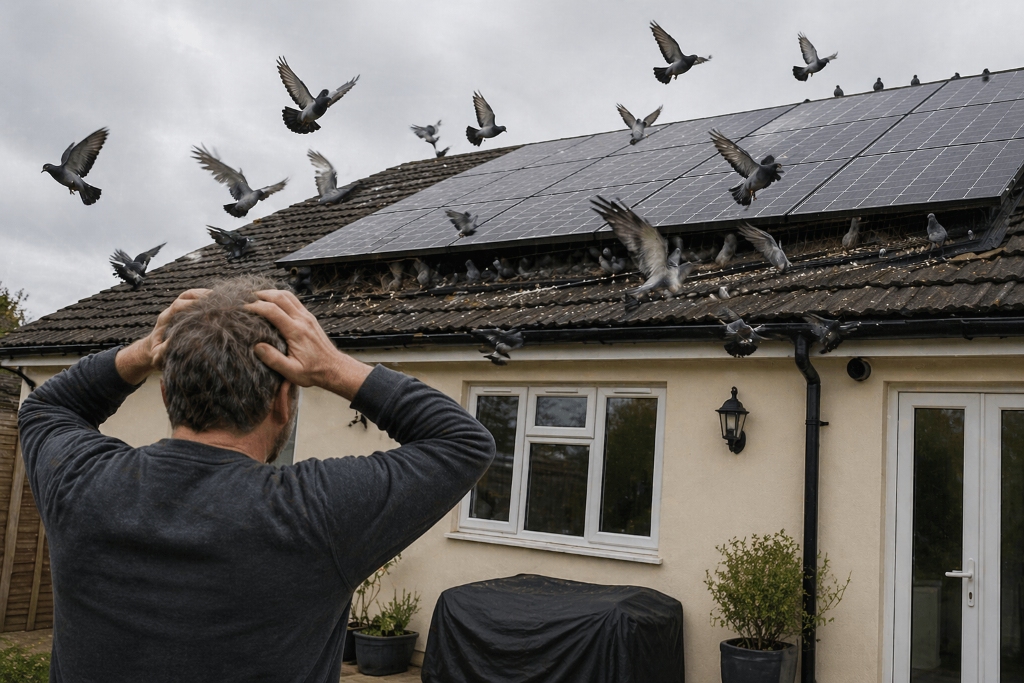
Bird Proofing Solar Panels
Stop birds nesting under your solar panels with permanent, warranty-safe stainless steel mesh. No scaffolding, no drilling — installed by specialists.
Fully Insured
Public Liability
5-Star Rated
200+ Reviews
7 Years
Specialist Experience
Guaranteed
Workmanship
Why Birds Are Attracted to Your Solar Panels
Solar panels create the perfect nesting environment for birds. The gap beneath a typical array — usually 10 to 30 centimetres — is warm, sheltered from wind and rain, and safely elevated away from ground predators such as cats and foxes. Pigeons, in particular, treat this space like a purpose-built loft, returning year after year to the same spot.
The dark surface of a panel also absorbs heat, and the air pocket underneath stays several degrees warmer than the surrounding roof. For a bird looking to raise young, that is ideal. Unfortunately for you, the same warmth that makes panels attractive to wildlife makes them vulnerable to damage.
The Hidden Risks of Leaving Nests in Place
Fire Hazards
Birds build nests from dry twigs, grass, straw and even scraps of plastic they find on the roof. These materials are highly flammable. When a nest is pressed against the underside of a panel or close to the junction box and wiring, a single electrical fault or arc can ignite it. Solar arrays generate significant DC voltage whenever the sun is out, and although fires are rare, a nest dramatically increases the likelihood and severity of an electrical incident.
Cable Damage
Pigeons and other birds peck and chew. The DC cables that run between panels and down to your inverter are covered in insulation that birds will strip away, exposing live copper. Damaged cables cause ground faults, reduce system output, and can trip your inverter offline — sometimes for weeks before the homeowner notices the drop in generation.
Insurance and Warranty Implications
Most solar panel manufacturers explicitly state that damage caused by wildlife is not covered by the product warranty. Likewise, many home insurance policies treat bird damage as gradual wear and tear rather than sudden damage, leaving the homeowner to fund repairs. An unaddressed infestation can void parts of your panel warranty and leave you personally liable for an expensive cable or inverter replacement.
How Bird Proofing Works
The most effective, humane and long-lasting solution is to install a permanent physical barrier — a strip of stainless steel or galvanised mesh — around the entire perimeter of the array. The mesh is fixed to the panel frame (not the roof) and bent to follow the edge, sealing the gap beneath the panels without touching the roof surface.
Crucially, the installation is no-scaffolding and no-drilling. Specialist clips attach the mesh to the underside of the panel frame, so there are no new holes in your roof, no tiles lifted, and no risk to your roof warranty. The birds are simply excluded — they cannot get back underneath the panels to nest.
Expected Lifespan of Bird Proofing
Quality stainless steel mesh is rated for 10 to 15 years and often longer. It will not rust, warp or degrade in UV light. Because it is fixed to the aluminium frame rather than the roof, it moves with the panels and will not come loose as temperatures change. A properly installed system is effectively a one-time fix.
Benefits of Professional Installation
- Done in a single visit — most residential arrays are fully proofed in a few hours.
- Warranty-safe — no drilling means your panel and roof warranties stay intact.
- Humane — birds are excluded, not harmed. Existing nests are removed outside the breeding season where possible.
- Protects generation — clean, clear panels keep your solar yield high.
- Prevents future damage — once the mesh is in, birds cannot return.
Common Mistakes Homeowners Make
The most frequent mistake is waiting too long. A single pair of pigeons under your panels in spring can become a flock of a dozen by the following year, and the mess — droppings, feathers, dead chicks and nesting material — accumulates quickly. The longer you leave it, the more likely cable damage becomes, and the harder (and more expensive) the eventual clean-up.
Another common mistake is attempting a DIY fix with chicken wire or plastic netting. These materials corrode, sag, and birds quickly learn to push underneath or peck through them. Worse, poorly fixed wire can scratch the panel glass or trap debris against the frame, causing its own damage.
Maintenance Advice
Once professionally proofed, bird mesh is essentially maintenance-free. We recommend a quick visual inspection once a year — usually when you or a cleaner are on the roof anyway — to confirm the mesh is intact and that no debris has built up against it. If you ever have panels removed for a roof repair, the mesh can be unbolted and refitted afterwards.
Areas We Cover
We install bird proofing across Worcestershire and the wider UK, including Gloucestershire, Herefordshire, Warwickshire, the West Midlands, Staffordshire, Shropshire, Oxfordshire and Monmouthshire. Wherever you are, get in touch for a free quote.
Get Your Free Quote
Every property is different, so we provide a tailored quote based on your panel count, roof height and access. There is no obligation and the whole process takes around 60 seconds — answer a few quick questions and we will call you back.
Bird Proofing: Professional Mesh vs DIY
| Feature | Professional Stainless Mesh | DIY Chicken Wire / Netting |
|---|---|---|
| Lifespan | 10–15+ years | 1–3 years |
| Warranty-safe | Yes — no drilling | Often no |
| Bird re-entry | Prevented | Common |
| Corrosion | None | Rusts / degrades |
| Animal welfare | Humane exclusion | Can injure birds |
| Maintenance | Near zero | Frequent repairs |
Why Choose Us
No scaffolding — typical install saves £300–£600 versus scaffolded jobs
No drilling — your panel and roof warranties stay fully intact
10-year workmanship guarantee on every installation
Specialist-only team with 7+ years fitting solar bird mesh
Fully insured with public liability cover
200+ five-star reviews from UK homeowners
How Our Installation Works
Free quote & survey
Send us your panel count and address. We give you a tailored price and, where useful, a quick roof check.
Clean-out (if needed)
Existing nesting material, droppings and debris are safely removed from beneath the panels before proofing.
Mesh fabrication
Stainless steel mesh is cut and shaped to the exact perimeter of your array on site.
Frame-clip install
Mesh is fixed to the panel frame with specialist clips — no drilling, no roof contact.
Final check
We walk you through the finished job and confirm the perimeter is fully sealed.
Common Mistakes Homeowners Make
Avoid these costly errors when dealing with birds under your solar panels.
Waiting too long
One pair of pigeons becomes a flock within a year. The longer you wait, the more damage and the higher the clean-up cost.
DIY chicken wire
Corrodes, sags and birds push underneath. It can also scratch panel glass and trap debris.
Netting that traps birds
Plastic netting tangles and injures birds, and tears loose in storms — an animal-welfare and maintenance nightmare.
Ignoring the cables
Even without a visible nest, birds peck cable insulation. Have the DC cables inspected when you proof.
Maintenance Advice
Annual Visual Check
Once a year, look up at your array from the ground or through a window. You are checking that:
- The mesh is still firmly in place around the full perimeter
- No twigs or debris have built up against the frame
- No birds are lingering underneath (a sign a gap has opened)
If Panels Are Removed
If a roofer or solar engineer needs to remove a panel, the mesh on that edge can be unclipped and refitted afterwards. Keep the off-cuts — they are cut to length for your array.
Keep the Surround Clean
Trim overhanging branches that drop leaf litter onto the roof; this reduces the debris that birds use for nesting material.
Before & After
Before & after photos coming soon.
Add image pairs in the Service Manager to populate this gallery.
10 years
Warranty & Guarantee
Every bird proofing installation is backed by a 10-year workmanship guarantee. The stainless steel mesh itself is rated for 10–15+ years of outdoor use. If the mesh ever comes loose or fails due to our installation within the guarantee period, we will return and put it right free of charge.
Frequently Asked Questions
Related Services
Pigeon Proofing Solar Panels
Pigeons are the number one cause of solar panel damage in the UK. Permanent mesh stops them nesting under your array — no scaffolding, no drilling, warranty-safe.
Learn moreSolar Panel Mesh Installation
The quality of your mesh — the material, the fixing method and the completeness of the seal — is what separates a one-time fix from a job that fails in a season. We install welded stainless steel mesh, fixed to the panel frame, never the roof.
Learn moreSolar Panel Cleaning & Bird Proofing
If birds have been under your panels, you have two problems at once: soiled panels and the birds still there. The complete fix is a single-visit clean and proof — clear the gap, clean the glass, then fit a permanent mesh barrier so they can't come back.
Learn moreProtect Your Solar Panels Today
Permanent mesh, no scaffolding, no drilling. Free quotes across Worcestershire and beyond.
We use cookies to improve your experience and analyse site traffic.