Bird Nest Removal From Solar Panels
Removing a bird nest from under your solar panels is only the first step — without proofing, the birds return within days. Here's how nests are safely and legally removed, the wildlife rules that apply, and why removal must be paired with a mesh barrier.
Fully Insured
Public Liability
5-Star Rated
200+ Reviews
7 Years
Specialist Experience
Guaranteed
Workmanship
Removing a Bird Nest From Under Your Solar Panels
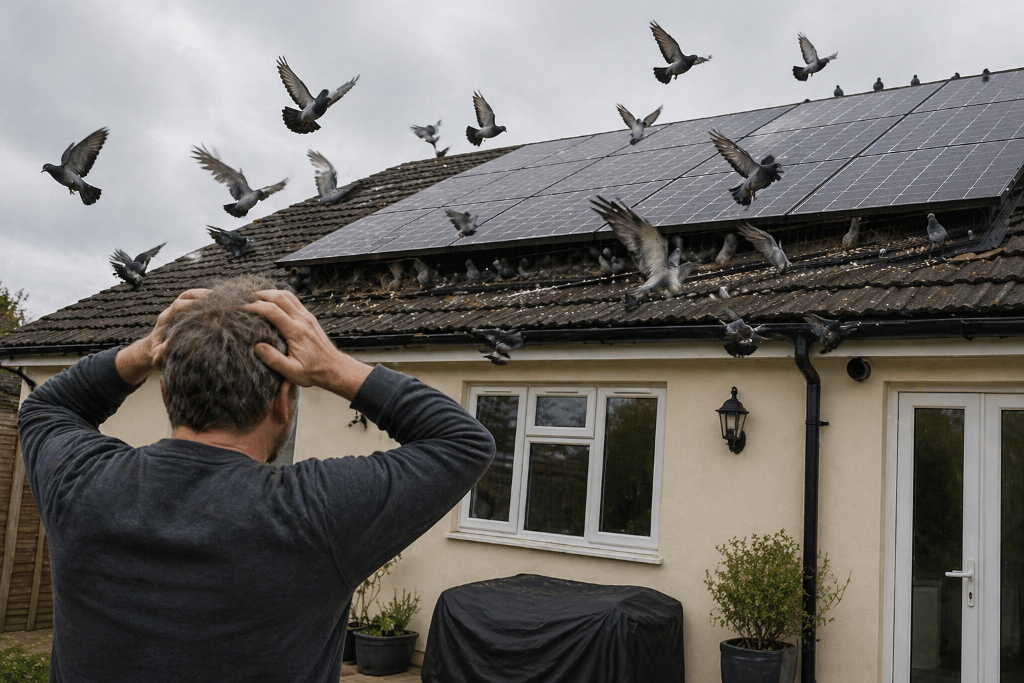
If you can see twigs, grass and droppings around the edge of your solar array, or you can hear birds scratching and cooing underneath, the chances are there is a nest in the gap beneath the panels. Removing it is the first step — but removal alone is not a solution. The birds will be back within days unless the gap is then sealed.
This page explains how nests are safely and legally removed, why removal must be paired with proofing, and the wildlife rules that apply.
Why Nests Form Under Solar Panels
The gap beneath a solar array is warm, dry and safe — an ideal nesting spot for pigeons and other birds. Once a pair establishes a nest, they return to it season after season and attract others. A single nest this year becomes a flock next year.
The longer a nest is left, the bigger the problems: more droppings, more cable damage, more flammable material pressed against the wiring, and more mess washing into your gutters.
The Legal Bit: Wildlife and the Breeding Season
In the UK, all wild birds, their eggs and their active nests are protected under the Wildlife and Countryside Act 1981. It is an offence to intentionally damage or destroy an active nest — one with eggs or live chicks.
This does not mean you cannot remove a nest from under your panels. It means the timing and method matter:
- Outside the breeding season (roughly autumn and winter), nests are no longer active and can be removed and the gap proofed.
- During the breeding season (roughly spring and summer), if a nest is active we wait until the young have fledged before removing it, then proof the gap immediately so the birds cannot return.
- Where a nest must be dealt with during the season for safety reasons (for example, a fire risk), we advise on the lawful approach.
We always work within the law and within good wildlife practice.
The Removal Process
- Assess the nest — check whether it is active. If it is, we plan the work for when the young have fledged.
- Protective removal — nests carry mites, bacteria and fungal spores, so we remove them with gloves, masks and proper disposal, not bare-handed.
- Full clean-out — we remove not just the nest but all droppings, feathers and debris from beneath the panels. Leaving the mess attracts birds back.
- Cable check — we inspect the DC cables for pecked or chewed insulation while the gap is open.
- Proof the gap — a stainless mesh barrier is fitted to the panel frame so birds cannot return to nest. This is the step that turns removal into a permanent solution.
Why Removal Without Proofing Doesn't Work
Birds are habitual. If you remove a nest and leave the gap open, the same pair — or a new one — will rebuild within days. You will be removing nests again next month. Removal is the start of the fix, not the end of it.
Proofing the gap with a stainless mesh barrier is what makes removal permanent. Once the perimeter is sealed, birds cannot get back underneath, so they cannot nest again.
Health Risks of Nesting Material
Nesting material is not just messy — it carries health risks:
- Bird mites can move from the nest into the roof void and bite occupants.
- Bacteria and fungal spores (including the organism that causes histoplasmosis) live in dried droppings and become airborne dust.
- Dead birds and chicks in old nests are a source of infection and smell.
Proper removal with protective equipment and full clean-out is important, not optional.
Fire Risk
A nest pressed against the DC cables or a junction box is a genuine fire hazard. Dry twigs and grass are flammable, and birds strip cable insulation, which can cause electrical arcs. Removing the nest and proofing the gap removes both the fuel and the cause.
Lifespan and Warranty
The stainless mesh barrier fitted after removal is rated for 10–15+ years and carries a 10-year workmanship guarantee. Because it is fixed to the panel frame (not the roof), no drilling is needed and your warranties stay intact.
Benefits of Professional Nest Removal
- Lawful — we work within the Wildlife and Countryside Act
- Humane — we wait for young to fledge during the breeding season
- Safe — protective removal with proper disposal
- Complete — full clean-out, not just nest removal
- Permanent — proofing stops the birds returning
- Warranty-safe — no drilling, no roof contact
Common Mistakes Homeowners Make
The biggest mistake is removing a nest without proofing — the birds return within days. The second is removing an active nest during the breeding season, which is an offence. The third is handling nesting material without protection, exposing yourself to mites and bacteria.
Areas We Cover
We remove nests and proof solar panels across Worcestershire and the wider UK — Gloucestershire, Herefordshire, Warwickshire, the West Midlands, Staffordshire, Shropshire, Oxfordshire and Monmouthshire.
Get Your Free Quote
If you have a nest under your panels, get in touch. We will assess it, plan the work lawfully and humanely, remove and clean the gap, and fit a permanent barrier so it does not happen again.
Nest removal vs nest removal + proofing
| Approach | Removes nest | Stops return | Lifespan | Humane |
|---|---|---|---|---|
| Removal + stainless mesh proofing | Yes | Yes | 10–15+ yrs | Yes |
| Removal only | Yes | No | Days | Yes |
| Leaving the nest | No | No | n/a | n/a |
| Proofing over an active nest | No | Yes | 10–15+ yrs | No |
Why Choose Us
Lawful, Wildlife and Countryside Act compliant removal
Humane — we wait for young to fledge in season
Protective removal with proper disposal
Full clean-out, not just nest removal
Cable inspection included
Permanent proofing so birds can't return
Common Mistakes Homeowners Make
Avoid these costly errors when dealing with birds under your solar panels.
Removing the nest without proofing
Removing a nest but not fitting a barrier means the birds rebuild within days. Removal without proofing is a temporary fix, not a solution.
Removing active nests in breeding season
Removing an active nest with eggs or chicks is an offence under the Wildlife and Countryside Act. Always check the nest is no longer active, or wait for young to fledge.
Handling nests without protection
Bird mites, bacteria and fungal spores live in nesting material. Removing a nest without gloves, mask and proper disposal is a health risk.
Leaving the mess behind
Droppings and debris left under the panels attract birds back even after the nest is gone. A full clean-out, not just nest removal, is needed.
Maintenance Advice
After Nest Removal
Once the nest is removed and the gap is proofed, birds cannot return. An annual visual check that the mesh is intact is all the upkeep needed.
Watch for Re-Entry Attempts
In the first few weeks after proofing, birds may try to get back in. If you see them lingering, let us know — a quick check confirms the perimeter is fully sealed.
Keep the Roof Clear
Trim overhanging branches that drop nesting material onto the roof, so birds have less to work with.
Before & After
Before & after photos coming soon.
Add image pairs in the Service Manager to populate this gallery.
10 years
Warranty & Guarantee
Where nest removal includes a bird proofing installation, it carries our standard 10-year workmanship guarantee on the mesh barrier. The stainless mesh is rated for 10–15+ years, so once the nest is removed and the gap is sealed, it is a permanent fix.
Frequently Asked Questions
Related Services
Bird Proofing Solar Panels
Stop birds nesting under your solar panels with permanent, warranty-safe stainless steel mesh. No scaffolding, no drilling — installed by specialists.
Learn moreSolar Panel Mesh Installation
The quality of your mesh — the material, the fixing method and the completeness of the seal — is what separates a one-time fix from a job that fails in a season. We install welded stainless steel mesh, fixed to the panel frame, never the roof.
Learn moreSolar Panel Pest Control
Solar panel pest control means clearing birds and squirrels from under your panels and stopping them coming back — humanely, with a permanent stainless mesh barrier. No poison, no inhumane traps, no drilling.
Learn moreProtect Your Solar Panels Today
Permanent mesh, no scaffolding, no drilling. Free quotes across Worcestershire and beyond.
We use cookies to improve your experience and analyse site traffic.